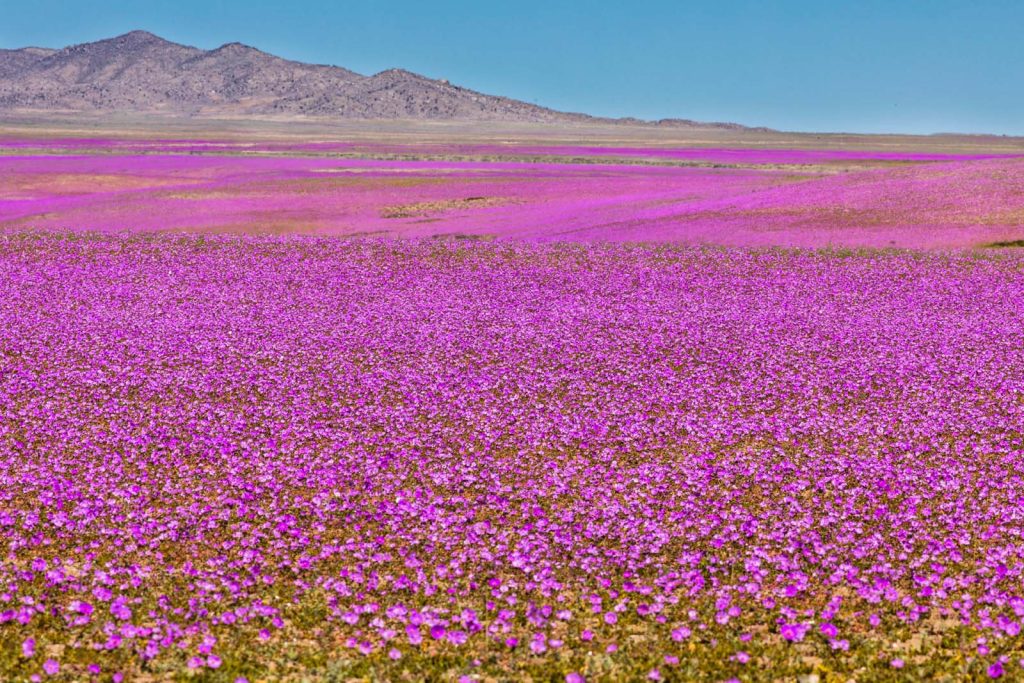
The flowering desert is one of the most fascinating springtime phenomena you can see, when more than 200 types of flowers bloom in northern Chile!
As strange as it may seem, the Atacama Desert—known as the driest in the world—can fill with more than 200 types of flowers during this event. Yellow, purple, pink, white, and red are just some of the hues you can spot, creating a surreal landscape that’s hard to find anywhere else in the world.
In addition, a historic Flowering Desert is expected for 2026 due to the unusually intense rains recorded during August. According to projections from the National Forestry Corporation (Conaf), the phenomenon could manifest in an area of up to 15,000 km².
When will the 2026 flowering desert happen in Chile?
The bloom is expected to begin in full in early September, reaching its peak during the second half of October and possibly extending into November. However, some areas of the Atacama Desert have already shown blooms of añañucas, huillis and suspiros since mid-August.

Where can you see the 2026 flowering desert in Chile?
The phenomenon can appear in different communes of the Atacama Region. For this season, areas of Huasco, Freirina, Vallenar, Caldera, Copiapó and Chañaral are being considered. The location and extent of the bloom may vary depending on the distribution of rainfall and the conditions of each area.
Some of the must-see spots where you can witness this event are Llanos de Challe National Park, located 90 kilometers northwest of Vallenar; Desierto Florido National Park, located 30 kilometers south of Copiapó; Caleta Chañaral de Aceituno; and areas of Totoral.
Does the flowering desert happen every year?
The flowering desert isn’t just any miracle! It’s a natural spectacle that only activates with a precise combination of rain and cold.
For this phenomenon to dazzle in northern Chile, between 15 and 30 mm of rain must fall, mainly between June and July. But it’s not enough to wet the ground—accumulating the necessary cold hours is also key to awaken the dormant seeds beneath the driest soil in the world.
Keep the following in mind if you’re going to see the flowering desert!
- Use established vehicle roads and don’t drive off-route. When walking, use only marked tracks and trails.
- Stop and park only in designated, safe places. Drive carefully.
- Don’t step on the plants, don’t handle or cut the flowers, and don’t collect seeds or bulbs; they will only grow in their natural environment.
- Don’t bring pets, as they disrupt the habitat of native flora and fauna species. Remember: pets are prohibited inside protected wilderness areas.
- Respect wildlife: don’t feed the animals, don’t make excessive noise, and don’t play loud music. Enjoy the sound of nature.
- Take your trash back to the city and dispose of it in designated places. Mutual respect among visitors is essential to enjoy the experience the desert offers us.
- You can report any damage done to the flowering desert to the Investigations Police (call 134) if you have any evidence, such as a photo of the vehicle’s license plate.
- You can get more information about blooms from the municipalities of Huasco, Freirina, Copiapó, Vallenar, Caldera, and Chañaral, as well as on CONAF and Sernatur platforms.
To ensure a smooth, peaceful experience, we recommend using tourism services registered with Sernatur. You can find them here.