More than 80 historic churches are scattered across the islands of the Chiloé archipelago, of which 16 were declared UNESCO World Heritage Sites.
These temples stand out for their architecture, history, and the traditions still kept alive by Chilote communities. The Chiloé Churches Route invites you to discover this cultural legacy.
The exceptional value of these temples lies in the combination of European and indigenous traditions. They are structures built with native species such as alerce, ciprés, coihue, and mañío, using sophisticated joinery techniques with wooden pegs and tenons instead of metal nails—a technique inherited from Chilote boat-building.
Which Are the 16 World Heritage Churches?
These churches are distributed across Isla Grande de Chiloé and the islands of Quinchao, Lemuy, Caguach, and Chelín, allowing you to discover different landscapes and communities along the route.
- San Francisco de Castro
- Nuestra Señora de Gracia de Nercón
- Santa María de Rilán
- Nuestra Señora de los Dolores de Dalcahue
- Nuestra Señora del Patrocinio de Tenaún
- San Antonio de Colo
- San Juan Bautista de San Juan
- Nuestra Señora del Rosario de Chonchi
- San Antonio de Padua de Vilupulli
- Santa María de Loreto de Achao
- Nuestra Señora de la Gracia de Quinchao
- Jesús Nazareno de Caguach
- Nuestra Señora del Rosario de Chelín
- Natividad de María de Ichuac
- Jesús Nazareno de Aldachildo
- Santiago Apóstol de Detif
5 Must-See Churches in Chiloé
First, we want to clarify that all the churches in Chiloé deserve to be visited. Each one has unique characteristics that will deepen your understanding of architecture and reveal the syncretism between European Christian tradition and Huilliche heritage.
That said, here we recommend 5 churches for your visit, either because they are the most iconic or because they serve as excellent starting points.
1. San Francisco de Castro Church

The most emblematic church in the archipelago and one of its main icons. Its striking yellow and violet façade, along with its 42-meter towers, dominates Castro’s Plaza de Armas. Built with native woods, it stands out as one of the finest examples of Chilote religious architecture.
2. Nuestra Señora de los Dolores de Dalcahue Church

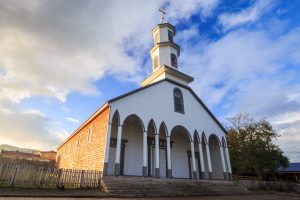
Located facing the Dalcahue channel, it stands out for its grand nine-arch portico and its construction in native woods. Visiting it allows you to explore one of the most traditional areas of the archipelago, along with its artisan market and views toward the nearby islands.
3. Santa María de Loreto de Achao Church

Built around 1740 by Jesuit missionaries, it is the oldest church still standing in Chiloé and the oldest wooden structure in Chile. It stands out for its baroque-style interior, more ornate than that of other temples in the archipelago.
4. Nuestra Señora del Patrocinio de Tenaún Church

Built from 1842 onward, it is one of the most recognizable churches on the route for its three towers, an uncommon feature among the heritage temples of the archipelago. It is also characterized by its colorful façade and the two large blue stars that adorn it.
5. San Antonio de Colo Church

Built around 1890, it is one of the most isolated and authentic churches on the route, standing alone on a hilltop overlooking the sea in Quemchi. Its rustic aesthetic stands out—entirely clad in unpainted alerce shingles with a ciprés structure resting directly on stone foundations, preserving the purest essence of Chilote architecture.
How to Explore the Chiloé Churches Route?
To fully explore the Chiloé Churches Route at a comfortable pace, the ideal timeframe is 3 to 4 days. The temples are distributed across Isla Grande de Chiloé and other islands in the archipelago, so the route combines road travel with ferry crossings.
If you prefer not to drive, there are also tour operators that offer excursions from Castro to the main heritage churches. These tours typically include transportation, ferry crossings, and guided visits to some of the temples.
Visit the Chiloé Churches Website
On the website https://www.iglesiaschiloe.cl/ you will find detailed information about schedules, maps, the history of each temple, and useful tips to plan your heritage route through the archipelago.
Chiloé Awaits You!

Visiting Chiloé is a true journey back in time. Here you will find community traditions that still endure, such as the minga, religious festivities, and the work of fiscales and patrons of the church—a legacy of the ancient circular mission promoted by Jesuits and Franciscans between the 17th and 18th centuries during the colonial period.