The Chinese dances are one of the country’s oldest religious and cultural expressions. Learning about them is an excellent way to delve deeper into Chilean culture.
Cover photo: baileschinos.cl
They are brotherhoods of musicians and dancers who express their faith through music, song, and movement within the framework of religious festivals in northern and central Chile. Their importance is such that, in 2014, the Chinese dances were inscribed as Intangible Cultural Heritage of Humanity by UNESCO.
Far from being a folkloric spectacle designed to entertain the public, the Chinese dances represent a profound manifestation of popular devotion, transmitted from generation to generation for centuries.
What are Chile’s Chinese dances and what is their origin?
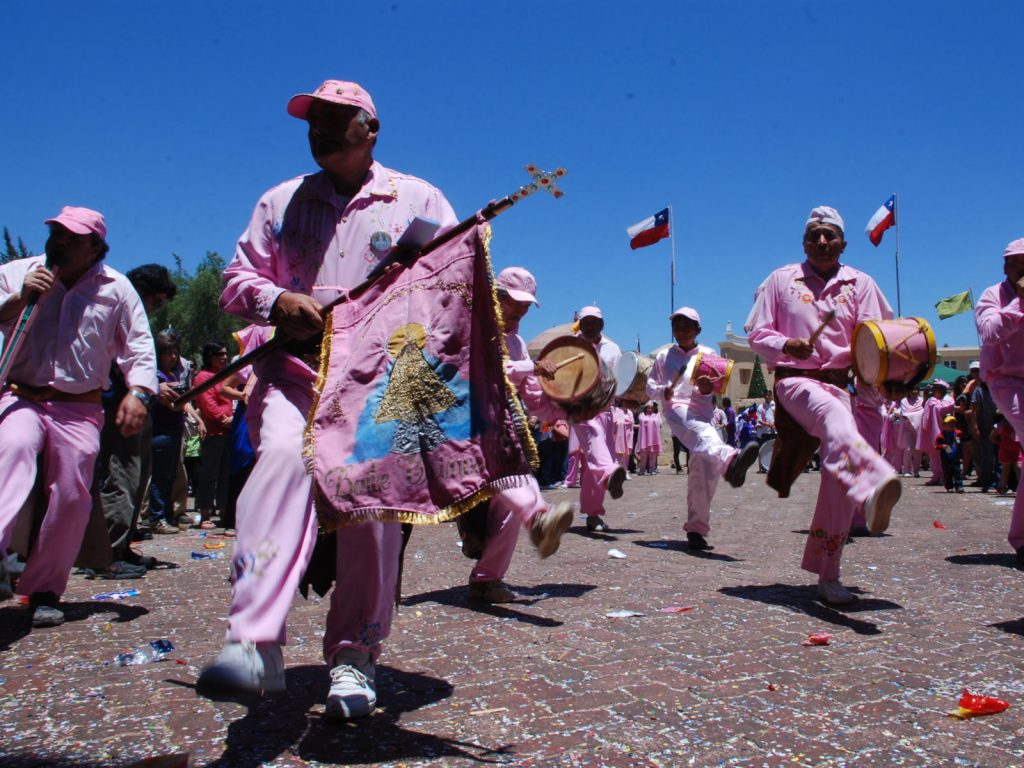
Emerging in the 16th century, the Chinese dances represent the fusion of pre-Hispanic indigenous traditions and Catholic liturgy introduced by Spanish colonization, becoming one of the most representative examples of Chile’s living cultural heritage.
Unlike other folk dances, this is not a spectacle or entertainment dance, but a communal and sacred ritual. Its members fulfill “mandas” or promises through music and physically demanding movements, characterized by jumps and leg bends
The members of each brotherhood are organized into the following roles:
- Chinese flutes: Musicians organized in opposing rows play these pre-Columbian flutes, made mainly of wood. They are distinguished by emitting a powerful, harsh, and enveloping sound.
- Drummers: One or more members of the dance are responsible for marking the rhythm and coordinating the movements of the brotherhood.
- The ensign or standard-bearer: Is the poet of the group and the one who transmits the community’s wishes and concerns to the sacred image through improvised songs in décimas.
Currently, there are five main styles of Chinese dances, differentiated according to the valleys and basins where they are performed, mainly between the Tarapacá Region and the Metropolitan Region.
Why are they called Chinese dances?
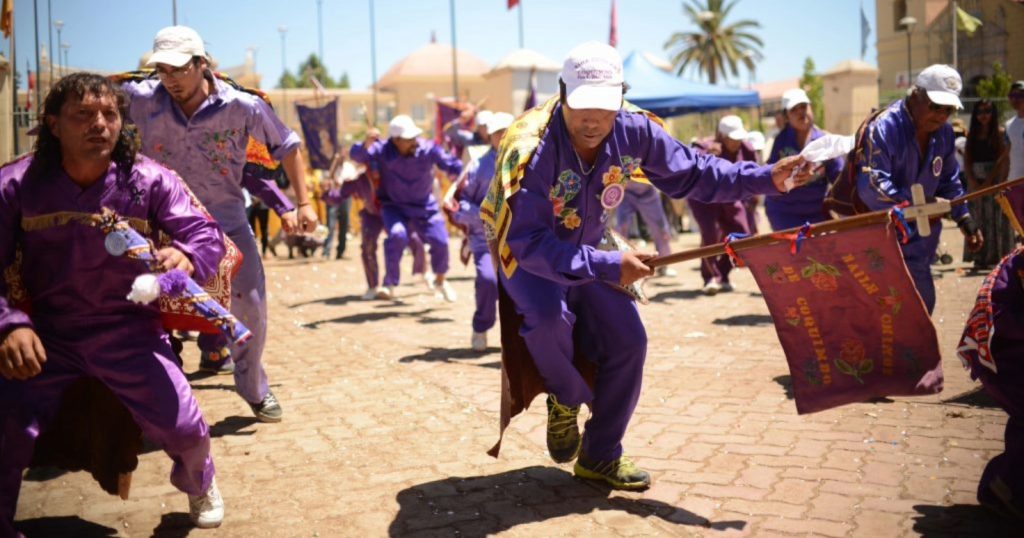
For many travelers, the name may be confusing. However, this tradition has no connection to Asia or Chinese culture. The term comes directly from Quechua and is associated with words like “servant” or “serf.”
It should be noted that, during the colonial era, the word “chino” or “china” had a derogatory connotation, used to refer to servants or people of low social status, often indigenous or mestizo. Over time, this term was re-signified by the brotherhoods as a symbol of devotion and religious humility.
Historically, the members of these brotherhoods called themselves “chinos” to position themselves as humble servants of sacred images and local religious advocations, such as virgins and patron saints, whom they affectionately call “chinitas.”
Where can you see the Chinese dances?
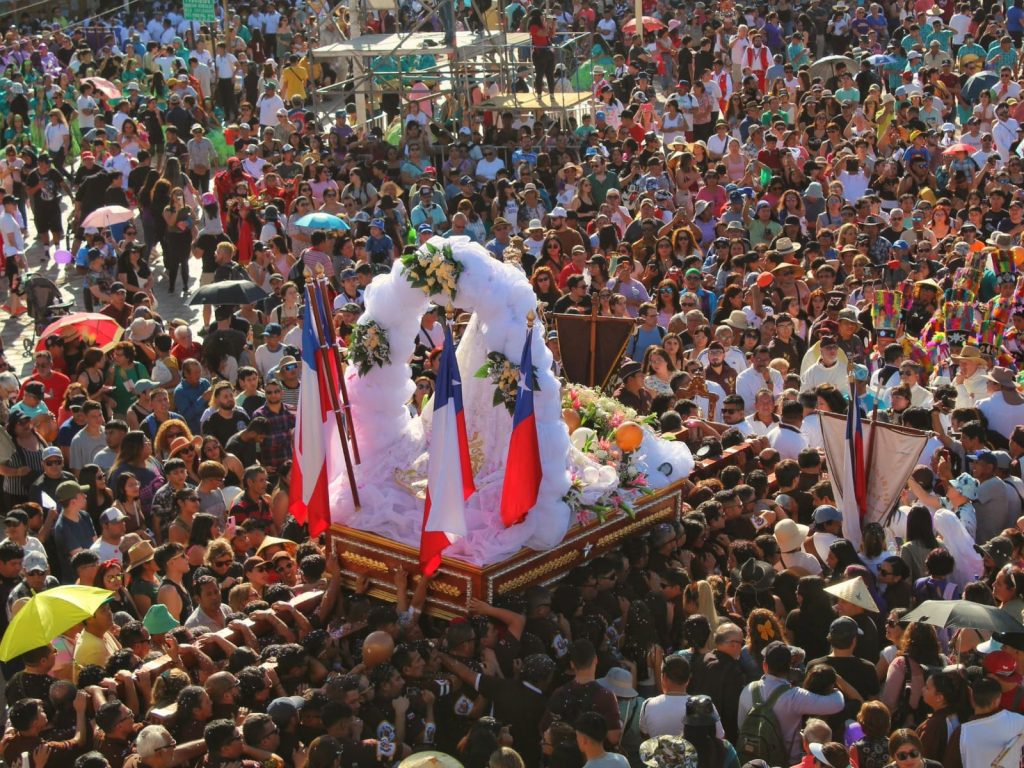
Chile’s Chinese dances are present in the most important religious festivals in the country. In these celebrations, the brotherhoods accompany processions, sing religious couplets, and in many cases, have the honor of carrying the sacred images.
You can see them at:
Fiesta de La Tirana in the Tarapacá Region
It is the most massive religious and folkloric celebration in Chile. It takes place annually between July 10 and 20 in the town of La Tirana, 76 kilometers from Iquique. The main days of the celebration are July 15 and 16, when the procession in honor of the Virgin of Carmen takes place.
Fiesta de La Candelaria in Copiapó
This festival is celebrated every February 2 in honor of the Virgin of Candelaria. Usually for three days, mining identity and religious devotion merge in the streets of Copiapó, capital of the Atacama Region.
Fiesta de Andacollo in the Coquimbo Region
In the Limarí Province, Andacollo holds the oldest documentary records of this tradition, with records dating back to the 16th century. The commune celebrates its Fiesta Grande between December 23 and 27, gathering brotherhoods from various localities and regions.
Check out the official Chinese Dances website!
Do you want to know more about this tradition, its brotherhoods, festivities, and cultural expressions? Visit baileschinos.cl, where you will find detailed information about the Chinese dances and their valuable heritage.